
What Probate Covers in Brown County
Probate is the court process for handling what a person leaves behind and for protecting people who cannot manage their own affairs. In Brown County it covers estates and wills, guardianship of adults and minors, conservatorship, trust accountings, and adult and juvenile civil commitments. The work runs through the circuit court, with the Register in Probate keeping the official record. The Register in Probate also assists the public and the courts with these matters.
The Register in Probate is appointed by the circuit judges, not elected. The office maintains the record for probate, mental health, guardianship, and conservatorship cases and performs an annual accounting of trust accounts. You can reach the Register in Probate at 920-448-4275. The office sits in the Brown County Courthouse alongside the circuit court branches.
Wisconsin does not run a separate probate court building the way some states do. Probate is a jurisdiction of the one trial court, the Circuit Court, and the Register in Probate is the office that holds the files. So when people ask about a Brown County probate court, the answer is the Circuit Court acting in its probate role, supported by the Register in Probate. That keeps estates, guardianships, and commitments under the same court system that hears the county's other civil and criminal cases, with one office dedicated to keeping the probate record.
Probate Terms Defined
Probate filings use words that do not come up in daily life. A quick guide helps you read an estate or guardianship file.
- Testator
- A person who makes a will.
- Executor
- The person named in a will to carry out its terms; also called a personal representative.
- Intestate
- Dying without a valid will, which sends the estate to state default rules.
- Guardianship
- A court arrangement giving someone authority over the care of an adult or minor who cannot manage alone.
- Conservatorship
- A court arrangement to manage another person's money or property.
How to Search Brown County Probate Records
Start with Wisconsin Circuit Court Access at wcca.wicourts.gov and select Brown County. Probate case numbers often use the code PR, guardianship uses GN, and mental health uses ME. If the case is restricted or not visible online, the Register in Probate can help.
- Open WCCA and choose Brown County in the county menu.
- Search by the decedent's or ward's name, or by a probate case number.
- If a file is restricted or absent, call the Register in Probate at 920-448-4275.
An absence from the public search does not always mean no case exists, because many guardianship and mental health files are confidential. The Records Management office at 920-448-4521 can also help with copies.
Register in Probate in Brown County
Probate in Brown County is centralized through the Register in Probate at the courthouse, rather than a separate probate court building. The contact card below is the office to reach for probate, guardianship, mental health, and conservatorship questions.
Brown County Register in Probate
Brown County Courthouse
100 South Jefferson Street
Green Bay, WI 54301
920-448-4275
Probate Filing Fees
Brown County does not publish a separate probate fee list on its public pages, so the statewide rules control. Filing fees are set under Wisconsin law, and copy or search fees are confirmed by the office before you pay. Use the table as a guide to where each amount comes from.
| Item | Amount |
|---|---|
| Probate and guardianship filing fees | Set under Wis. Stat. § 814.61 |
| Certified or plain copies | Confirm with Records Management, 920-448-4521 |
| Where to verify amounts | Wisconsin Court System fee schedule |
Because amounts change, confirm the current fee with the Register in Probate or Records Management before filing or ordering a copy.
How Probate Works in Brown County
Probate follows a set path, though the exact steps depend on the case type. A formal or informal estate, a small-estate transfer, a guardianship, or a trust matter each has its own track under Wisconsin law. The common flow for an estate looks like this.
- Decide which process fits, such as formal probate, informal probate, or a small-estate transfer.
- Gather the death certificate, the original will, and asset, debt, and heir information.
- File the Wisconsin circuit court probate forms with the Register in Probate.
- Pay the filing fee, or file a waiver if eligible.
- Give notice to interested persons and creditors as required.
- Attend any hearings the case type or the court requires.
- File the inventory, accountings, claims responses, and closing documents.
- The court reviews the filings and issues the orders that close the estate.
A guardianship or conservatorship follows a similar pattern of petition, notice, hearing, and order, with extra protections for the person under care. Statewide forms cover most of these filings.
What Brown County Probate Records Show
An estate file follows the case from opening to closing. It can show the filing date, the decedent, the personal representative, and the interested persons or heirs. As the case moves, it adds notices to creditors, an inventory of assets, claims, accountings, and the orders that distribute property. A guardianship or conservatorship file shows the petition, the protected person, and the orders that set the arrangement. Trust matters add an annual accounting that the Register in Probate reviews each year.
Common documents include the application or petition, the will, proof of heirship, letters that appoint a personal representative, notices, the inventory, claims, accountings, and the final judgment or order assigning property. Some documents, such as physician or psychologist reports, are restricted even within an otherwise viewable case. A Brown County probate file therefore mixes public administrative documents with protected reports, and the Register in Probate decides what a member of the public may see in a given case.
Restricted Probate Records
Several probate-related records stay closed. Mental health and treatment records are confidential under Wis. Stat. § 51.30, so civil commitment files are not ordinary public records. Many guardianship medical reports are also restricted, and adoption records are closed by separate law. Minor information and financial account numbers are protected.
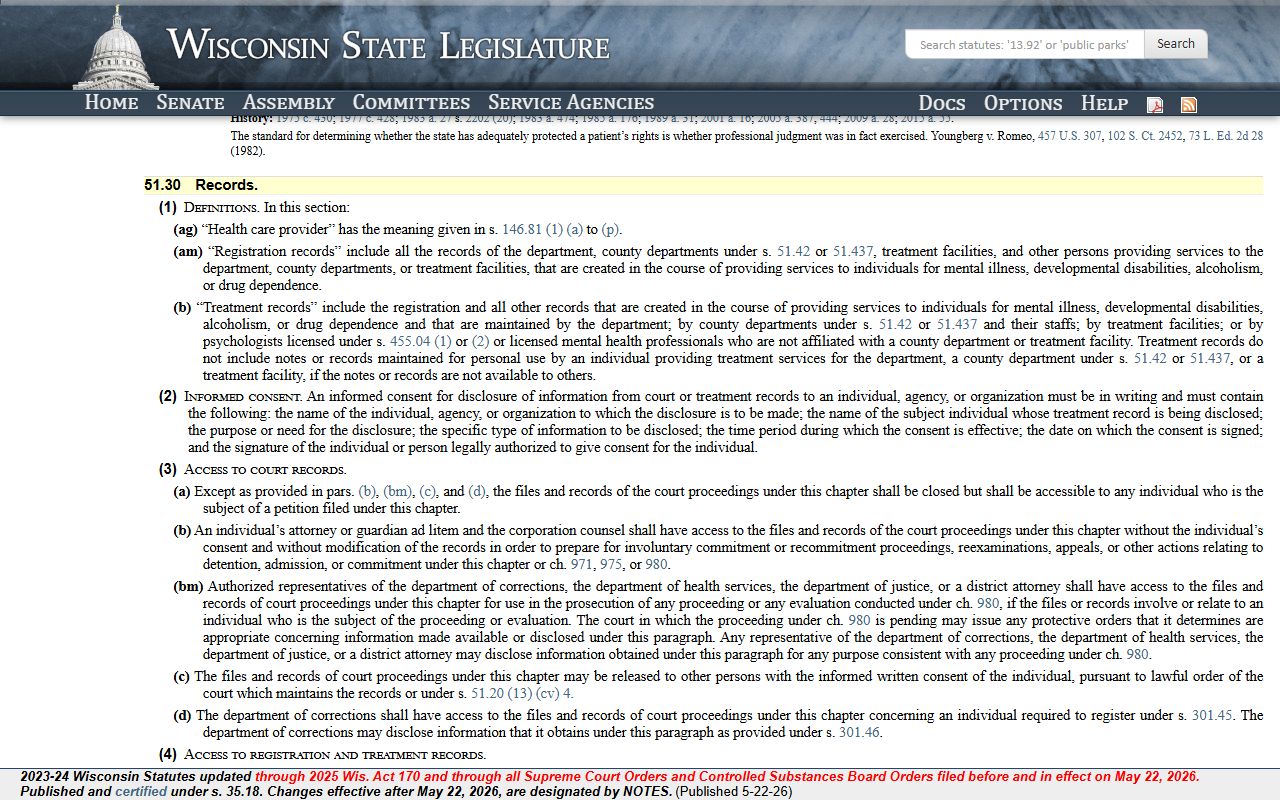
So a guardianship or mental health matter may exist without showing on a public search. To view a restricted probate file, a person usually needs to be a party, an attorney of record, or someone with a court order, and the Register in Probate can explain the process.